“If only my dog could talk!” I’m sure every pup parent has said that at least once. Luckily, learning how to read dog body language is like learning your dog’s unspoken words!
Whether you’re trying to get to know your new dog’s personality after bringing them home, or just trying to figure out what your dog means when they do that silly thing they do, it would be great if our dogs could talk to us, right?
Well, what if I told you they can — it’s just not with spoken words.
Just like people, dogs use body language to convey their feelings and needs. But since it’s one of their main forms of communication (alongside barking), learning what your dog’s body language means is crucial for being able to interact with them.
Let’s break down dog body language for you so you can better communicate with your pup.
TAIL DOG BODY LANGUAGE
Tail movement is one of the most common non-verbal communication signals, but it can also
be one of the most misunderstood.
Many people associate tail wagging with being happy or excited, but that’s not always true.
While it’s true that tail wagging is a signs of being emotionally aroused, it doesn’t necessarily
mean excitement. It could be frustration, fear, or other negative emotions.
Here’s how to tell: The speed of the wag. A long, slower, back-and-forth wag indicates excitement, while a faster twitch-like wag can indicate that your dog is on alert.
- The direction of the wag. According to a research study, dogs’ tails tend to wag to the right when for positive reasons and left for negative ones.
- The position of the tail. The higher the tail, the more assertive or aggressive the dog is feeling. A low tail that hangs between the legs can signal fear. Neutral tail position is a sign of a relaxed, happy dog. Neutral may look different on different breeds, so be sure to take note of your dog’s tail position when you know they are relaxed.
BACK DOG BODY LANGUAGE
Raised hackles (piloerection) – when the hair on your dog’s back stands up – can be a sign of
emotional distress. Sometimes it signals intense sudden interest, but more often than not it’s a
sign of stress.
If your dog’s hackles are raised when meeting a new person or dog, they may feel intimidated
or unsure of who they are meeting. When you don’t know what your dog is trying to
communicate to you, you can potentially put them in harmful or stressful situations.
POSTURE IN DOG BODY LANGUAGE
Overall posture can tell you a lot about your dog’s mood and feelings. Here are some key
postures to note:
- Cowering or crouching can be a sign of fear or stress
- Shifting weight forward can mean your dog is interested in something. However, if it’s paired with aggression signals like a twitching tail, it could mean your dog is on the offensive
- Rolling over and exposing their belly usually means a relaxed or happy dog
- Placing the chest on the ground and lifting their bottom in the air means they want to initiate play with another dog or person.
- A raised paw can mean your dog is unsure or insecure. In pointing breeds, that can also mean nearby prey.
FACE & EARS DOG BODY LANGUAGE
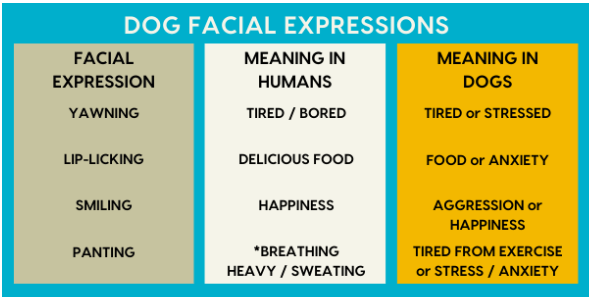
- Facial expressions in dogs are a little different than in humans. Dog body language is often the most clear in your dog’s eyes, ears, and mouth. Let’s break down some of the main differences:
- Yawning. Dogs yawn when they are stressed, in an attempt to calm themselves. Some behaviorists even say you can “yawn” at your dog when they’re tense to help calm them down
- Pinned ears. Often, if your dog’s ears are pinned back against their head it can be a sign of stress or concern
- Whale eye (or side eye). If a dog is giving side-eye or “whale eye” by not making eye contact and showing a lot of the whites of their eyes, it can be a sign of nerves and stress
- Lip-licking. If your dog has just finished eating, lip-licking is just a normal function. But if there’s no food involved, it may be a sign of anxiety
- Smiling: this is a tricky expression to figure out. If dogs are baring their teeth in a snarling manner, they’re showing aggression. But if it’s paired with a playful, relaxed posture, you can interpret it more as a smile that you would see from a human. The key is to get to know your dog and their accompanying postures and signals
- Panting. We know that dogs pant after exerting themselves, but they can also be panting as a sign of stress and anxiety when not associated with exercise.
Learning to read your dog’s body language takes time and practice like any other language. The best way to learn is by spending quality time with them.
Pay attention to their face, body, and posture during times like playtime, during feeding, when
they’re tired, and when they’re interacting with other dogs. This will let you see their “baseline”
body language as well as how it changes given the situation.
Have a Pawfect Day!
Kat
*Information courtesy of “Pupford Article from Feb, 2021”
Discover more from MadKat Dog Training
Subscribe to get the latest posts sent to your email.
 MadKat Dog Training